The Clam Chair: The History of Arnold Madsen and the Muslingstol
Designed in Copenhagen in 1944 by Arnold Madsen, the Clam Chair has become one of the most distinctive lounge chairs of the Danish Modern era. Here we recount its origins in Denmark, later production in Norway, and the eventual reattribution to Arnold Madsen.
Arnold Johan Madsen was born in 1907 in Sønderlev, Denmark. He was one of six children of the shoemaker Mads Madsen and his wife Anna. Arnold’s father placed great value in a good education for his children and sent his sons to complete apprenticeships as craftsmen when they left school. Arnold's path to becoming a furniture designer, however, was unconventional. He initially found work as a sailor and later travelled to the United States in 1929, where he worked for a year, before returning to Denmark to begin an apprenticeship in upholstery.

An early Clam Chair made by Madsen & Schubell in Copenhagen c. 1945–50 with oak arms and legs.
The Origins of the Clam Chair
By 1941, Madsen was a fully trained and highly skilled upholsterer, living and working in Copenhagen, where he started his own business: A. Madsen Møbelpolst (Arnold Madsen Furniture Upholstery). In 1943, he relocated to a small basement workshop at Gothersgade 158B, a short walk from Rosenborg Castle. Most of his time was spent reupholstering chairs and sofas for private clients, but during the German occupation of WWII it became increasingly hard for Madsen to make a living, due to the depressed economy.
Despite these challenges, it was in this modest workshop where Arnold began experimenting with furniture design. His aim was to have his own exclusive chair that he could upholster and sell through local shops. His breakthrough came in 1944, when he created the Clam Chair or 'Muslingstol', in Danish; a unique, playful lounge chair that drew inspiration from the shape of an open clam shell. The fluid design, with its club-shaped legs and simple, curved arms, reflected a new zeitgeist that had been brewing amongst young Danish architects such as Viggo Boesen, Finn Juhl and Flemming Lassen. The heavy, historical design modes of previous generations were gradually being replaced with simpler, biomorphic forms, inspired by the natural world and better suited to new modernist Danish homes. From humble beginnings, the Clam would go on to become one of the most distinctive Danish lounge chairs of the mid-century modern period.

Clam Chair without arms made by Madsen & Schubell in Copenhagen c. 1945–47 with oak arms and legs. Image courtesy of Bruun Rasmussen Auctioneers.
Building the First Clam Chair: From Plaster Model to Wood Frame
Madsen lacked formal design training. He had not studied architecture or drafting, as was the case with many of his contemporaries in Copenhagen’s burgeoning furniture community. So, rather than commit his idea for the Muslingstol to paper, he hand-formed a full-scale model in plaster. Through necessity and technical limitation, he found an elegance and immediacy in his design process that goes some way to explaining the organic charm of the masterpiece he created.
His next challenge was to find a cabinetmaker who would take on the distinct challenge of converting his simple model into a durable wood frame. After many rejections, he knocked on the door of local furniture makers Winter & Winding. The foreman at the time was Henry Schubell, a talented young cabinetmaker just one year older than Arnold. Thankfully Henry agreed to take on the complicated task and started developing the first Muslingstol frames at Winter & Winding’s factory. He developed a unique way to join the chair’s frame without compromising its shape, that distributed weight evenly and ensured the chair remained structurally sound. Henry’s son, Fleming Schubell (also a skilled cabinetmaker), recalled: "The joinery was so difficult to make with just a bandsaw that no one else could do it. As long as Winter & Winding produced the frames for Arnold Madsen, my father had to make all the parts himself".
Arnold was delighted with the results and so impressed by Henry’s creativity that he immediately commissioned him to make the first batch of Clam frames at Winter & Winding's factory.

Arnold Madsen (seated) and Henry Schubell (standing), in their factory office, c. 1950s
The Clam Chair was unlike most contemporary lounge chairs available in Denmark at the time. Its uniquely shaped concave seat and upright, curved arms made it light, playful and practical, but above all, comfortable. Arnold upholstered the chairs in a variety of carefully chosen fabrics and took them to local furniture dealers including his neighbour on Gothersgade: Olsson Møbler, the high-end Illum Bolighus department store and recently opened NY FORM. The Clam Chair sold well and soon all of Arnold and Henry's time was occupied producing chairs to keep up with orders. Their earliest editions featured oak arms and legs fixed to a beech wood frame, with a combination of glued dowels and steel bolts. The chair was padded with coir fibre and wool felt over jute webbing for support. Arnold finished the chairs with seven rows of deep buttons, which created the concave shape and added a visual flourish.

An early Madsen & Schubell produced Clam Chair and prototype sofa shown in the Danish magazine "Bygge og Bo", 1945.
In 1945, Schubell agreed to leave Winter & Winding and work with Madsen full-time at his Gothersgade workshop. Their partnership, Madsen & Schubell, was then officially established. They soon followed the success of the Clam with their next creation, the Pragh Chair, in 1948. It was a natural evolution of the Clam, albeit a larger, more eccentric cousin, featuring similarly innovative joinery, deep pulled buttons throughout the seat and flowing, organic curves.
Arnold Madsen's daughter Johna was born in 1943, a year before her father created the Clam. She grew up surrounded by the history of Madsen & Schubell, in a house filled with their furniture. She recalls with great clarity her father's life and work: "My father was a furniture man, and the Muslingstol belonged to him and our family. He was also generous - one Clam Chair ended up in my uncle's house, another was given to my cousin for her wedding, and one had pride of place in my brother Ib's room”.
According to Johna, her father would often talk of how he developed the Clam in his Gothersgade workshop, and how it afforded him the creative and financial foundations for his partnership with Henry Schubell that lasted nearly 20 years.
The significance of the Clam in Arnold’s life was commemorated on the occasion of his 50th birthday, when his employees wrote a song for him including the lines: “Under the war’s shortages, many an upholsterer had to retreat, if he couldn’t get a customer nestled in a clam shell seat. Arnold learned a lot, and yes, he made quite a pile.”
 Arnold Madsen’s 50th birthday song lyrics, written by his factory staff, 1957
Musling: Vik & Blindheim Bring the Clam Chair to Norway
By the end of the 1940s, Madsen & Schubell was a fully fledged furniture company, having added several more chairs to their catalogue, including Model 4 with its flowing arms that wrapped around the back of the upholstered seat. Each year they would travel to the annual Fredericia Furniture Fair - Møbelmessen Danmark - to exhibit their collection and make new contacts. Around 1950 they met a Norwegian sales agent named Sigurd Hassing who had travelled to Fredericia with Karl Blindheim, co-owner of Norwegian furniture factory Vik & Blindheim Møbelfabrikk. Blindheim was looking for new designs to license for his domestic market, so Hassing introduced him to Madsen & Schubell. He was so impressed by the Danish chairs including the Clam and Pragh that he proposed a deal to license them for production at his own factory in Sykkylven on the West Coast of Norway.
Hassing's son Ole Christian, who also worked in the furniture business, recalls: "My father convinced Arnold Madsen of the cooperation. Our families became friends and there was a long business relationship between my father and Madsen. There is no doubt that Arnold Madsen designed the Clam Chair," says Hassing. "My father talked a lot about furniture. He often mentioned Arnold Madsen, as well as the Clam. Both belonged together."

(L) Madsen & Schubell’s collection including the Musling, Pragh and MS-4 chairs, featured in a Vik & Blindheim advert in Norwegian journal: Møbelhandleren, June 1952. (R) Original Clam Chair photo used for the Vik & Blindheim advert, supplied by Arnold Madsen. Image courtesy of Madsen family archive.
Whilst Madsen & Schubell would continue producing the Pragh and MS-4 chair (known as Model 280 in Norway) for the Danish market, the Clam Chair would become exclusive to Vik & Blindheim in Norway, with royalties paid to Madsen for each chair sold. Arnold and Henry agreed to the deal and by 1951 their furniture was appearing in Norwegian magazines, such as Bonytt, and in furniture shops across the country, including Maison Nordique, Tr. Finnstein and Martin Olsen. As was customary for Vik & Blindheim, they did not credit their designers in their catalogues. Instead they used model names and numbers only under their own brand. Prior to the licensing deal with the Danes, Karl Blindheim had designed all of the company's furniture since its inception in 1941.
Madsen & Schubell continued making the complex Clam frame for Vik & Blindheim for the first few years that it was sold in Norway. To help with the transition, they sent their own staff to train the Norwegian cabinetmakers in Sykkylven, who eventually took over full production. Throughout Norway, Vik & Blindheim marketed the chair simply as ‘Musling’. This new edition was extremely close to Madsen & Schubell’s original in size and proportion. However, whereas in Denmark it was generally made with oak arms and legs, in Norway they used beech wood, either lacquered in its natural state or stained dark to mimic teak and mahogany. The Musling was amongst their best-selling chairs throughout the 1950s and until the factory closed in 1967.

The Clam Chair listed as ‘Musling’ in a Vik & Blindheim sales catalogue, c. 1955
Success and Evolution: Madsen & Schubell in the 1950s
In 1951, flush with success thanks to the improving economy in Europe, Madsen & Schubell moved to a larger factory at Biblioteksvej 55 in Hvidovre, south of Copenhagen. Demand for their collection had been steadily increasing, so much so that Arnold later opened a dedicated upholstery workshop near his home in Horsholm. A slew of new designs would be launched in the 1950s, including models MS-6 and MS-5. The latter was developed specifically with the US market in mind and was imported exclusively by New York dealer George Tanier. Another ingenious design from Arnold was the classic MS-9 chair, later known as the 'Oda Chair’, named after legendary Japanese collector Professor Noritsugu Oda who featured it in his essential book: 'Danish Chairs' (1999). For the MS-9, Madsen taught himself how to weld and developed a unique type of wood frame joined to a metal base.

Madsen & Schubell MS-6 Chairs featured in the George Tanier Inc. catalogue, New York, 1956
End of an Era: The Disappearance of Arnold Madsen’s Clam Chair
In 1963, after nearly 20 years of hard work and success, Madsen & Schubell formally dissolved their partnership. Henry and his son Flemming, who had worked as a cabinetmaker at the factory since 1958, would form a new company: Schubell & Son. Meanwhile, Madsen continued his upholstery business with his own son Ib Madsen, retaining the Madsen & Schubell brand name and using the Schubell’s to produce their frames.
The Clam Chair had disappeared from the Danish market in the early 1950s, but had sold in large numbers throughout Norway into the 1960s. By 1967, changing market conditions led to the closure of Vik & Blindheim and the factory was eventually sold to local furniture company: Ekornes. It was at this point that production of the original Clam Chair ceased once and for all. It would remain largely forgotten for nearly fifty years, before making a memorable reappearance at auction in London in 2013.
 A Clam Chair with lacquered beech arms and legs, upholstered in blue textured fabric. Produced by Vik & Blindheim in Norway, c. 1952-1960
Mistaken Identity: The 2013 Misattribution of the Clam Chair
Both Madsen & Schubell's Danish-made Clam Chairs and Vik & Blindheim's later versions were largely unknown outside of Norway until 2013, when a pair of vintage Musling chairs, which had been reupholstered in sheepskin, were sold for £146,000 by London auction house Phillips. The listing incorrectly attributed the design to Norwegian furniture retailer Martin Olsen, who had sold Vik & Blindheim's products in the 1950s and whose own label had been found attached to one of the chairs. The eye-catching result was unexpected, and generated renewed interest among dealers and collectors, who began investigating the seemingly mysterious Norwegian chair’s origins. The eagerness to identify the Clam’s designer led to several more misattributions, including Danish architects Viggo Boesen and later Philip Arctander, whose name remained attached to the chair in auction listings for several years in place of a better explanation.
Arctander was a celebrated Danish architect and published author who served as Director of Danish Building Research Institute (SBI). He was known for his vibrant criticism of modern residential architecture in Denmark and conducted studies on behalf of the Danish Furniture Manufacturers’ Trade Association. His limited furniture design output was fairly prosaic, including a simple armchair with built-in reading lamp drawn for the annual Cabinetmakers Guild Exhibition competition in 1940 and a painted bed frame prototype for the NY FORM retailer in Copenhagen in 1946. However, none of his designs went into serial production.

Philip Arctander’s submission for the annual competition at the Copenhagen Cabinet Maker’s Guild Exhibition in 1940. The prototype was made by cabinetmaker Peder Pedersen.
After several years of extensive research, the little-known story of Arnold Madsen and the Clam Chair was first published by German journalist Oliver Fischer in 2020, with support from a team of international experts including Aaron FitzGerald. The evidence confirming Arnold Madsen as the designer included first-hand accounts from Arnold’s daughter Johna, Henry Schubell’s son Flemming, Ole Christian Hassing, the son of the Norwegian sales agent, Sigurd Hassing and a recorded interview with Karl Blindheim in 1989, all of whom confirmed Arnold Madsen as the designer of the Clam Chair.
 Arnold Madsen's daughter, Johna Møhring-Andersen, pictured seated in a new edition of the Clam Chair produced by Dagmar, 2023.
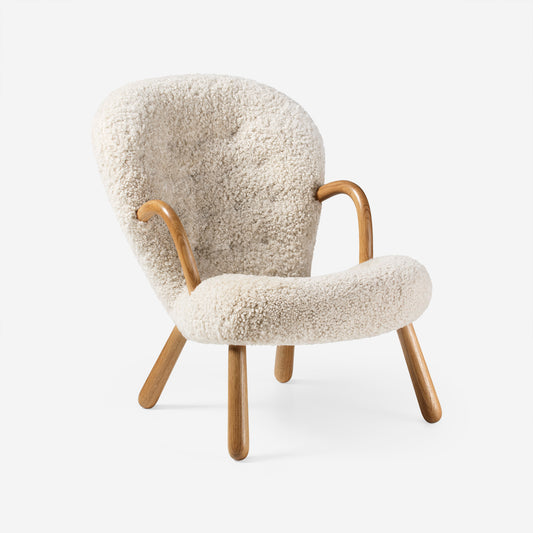
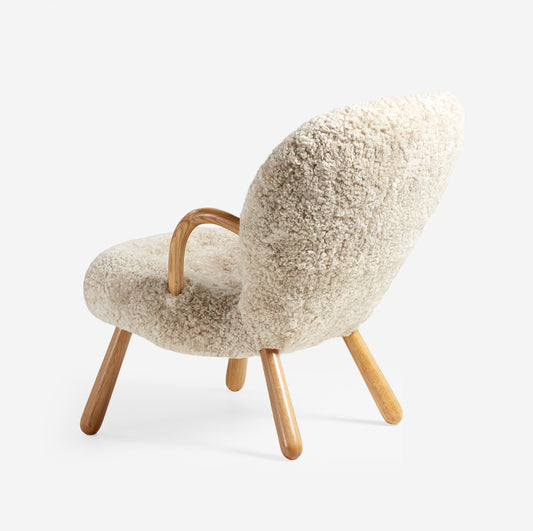
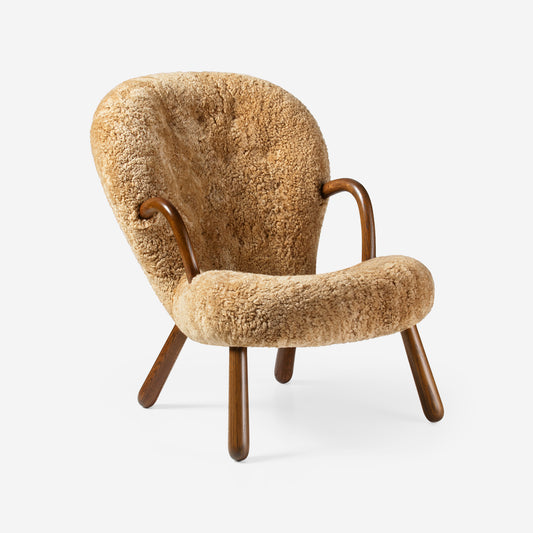
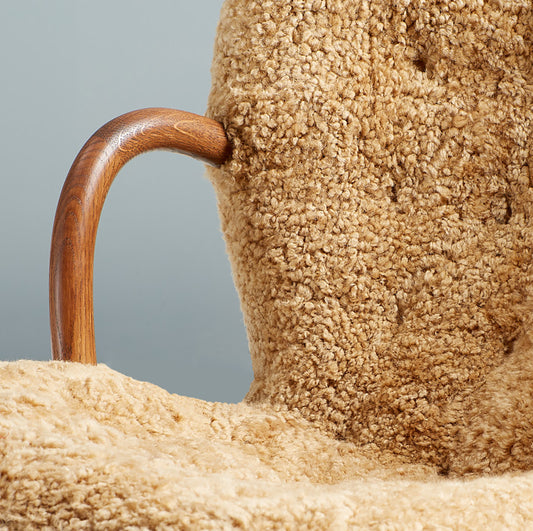
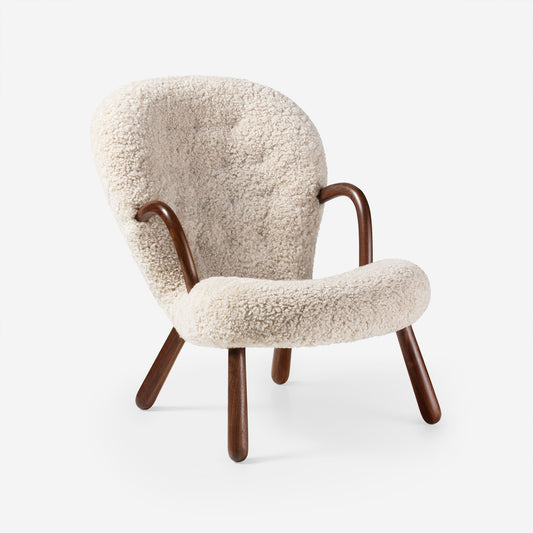
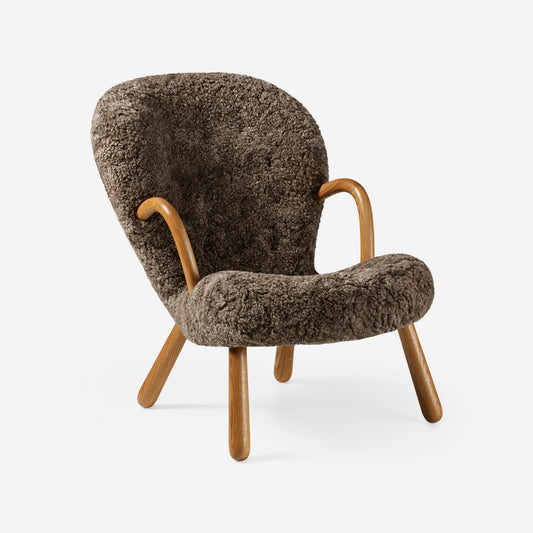
The following year, Dagmar founder Aaron FitzGerald struck an agreement with Arnold Madsen’s daughter Johna Møhring-Andersen to produce an official version of the Clam Chair, faithful to Arnold’s original vision and Henry Schubell’s cabinetmaking expertise. After many months of detailed development work, Dagmar relaunched the official new edition of Arnold Madsen's Clam Chair in 2022, nearly 80 years after it was conceived. The new chair follows the principles of Arnold and Henry’s original, with a frame crafted from solid beech wood and arms and legs in oak.
Legacy: Arnold Madsen's Clam Chair Returns in 2022
The rediscovery of Arnold Madsen’s authorship of the Muslingstol offers insight into how 20th century Danish design history has been recorded and retold. Furniture of the 1940s and 1950s is often understood through the work of architect-trained figures such as Hans Wegner, Ole Wanscher and Finn Juhl, working in close collaboration with established cabinetmakers. Yet a parallel tradition existed among the many industrious craftsmen operating on the fringes of the community who developed designs through material experimentation rather than architectural drawing.
The Clam Chair’s misattribution arose from circumstances that were not uncommon: Vik & Blindheim’s practice of marketing furniture without explicit designer credits and the passage of decades without systematic documentation created confusion around a beloved and successful chair. Clarifying its authorship required careful research across archival sources, family records and first-hand testimony. The case illustrates how fragile design attribution can be over time, and how it can be restored.

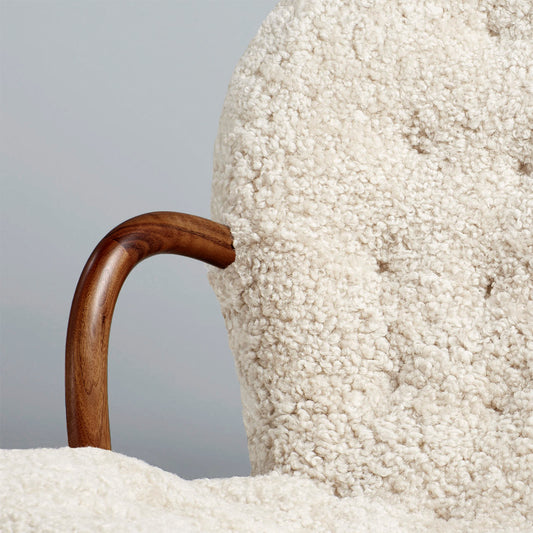
A Clam Chair upholstered in sheepskin with oak arms and legs. Produced by Dagmar in Sweden, 2025
Arnold Madsen passed away in 1989, long before the renewed interest in the Clam Chair’s second life. While respected in his own era, he did not achieve the enduring recognition afforded to some of his contemporaries. Today, the Clam Chair stands not only as an emblem of post-war Scandinavian Modern design, but as a testament to Madsen’s skill and independence as a designer. His contribution to Danish furniture history is now more clearly understood. The Clam Chair remains one of the most distinctive Danish lounge chairs of the period and continues to find new audiences.
Written by: Aaron FitzGerald
Primary research by: Oliver Fischer, Zephyr Renner & Aaron FitzGerald
Additional research by: Mats Linder, Thomas Flor & Peter Kjelgaard
Originally published February 2026
The below sources informed the research and attribution presented in this article.